

Rampur, September 8 – In an agriculture-based country like Nepal, cattle and buffaloes hold enormous potential for boosting milk production. However, farmers have long faced a major challenge: the inability to perform artificial insemination (AI) at the right time. Errors in heat detection, silent heat, insemination at the wrong stage, and low conception rates have all contributed to production losses.
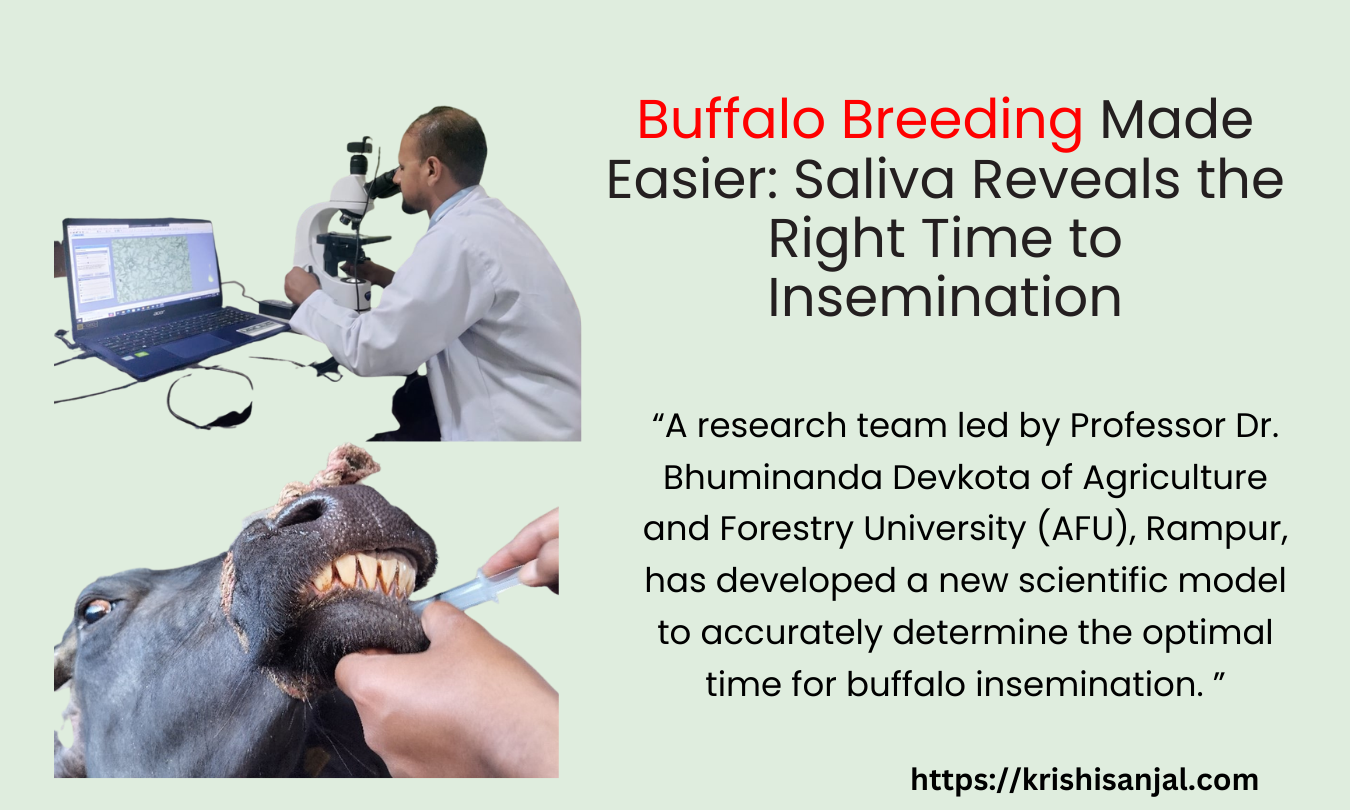
To address this challenge, a research team led by Professor Dr. Bhuminanda Devkota of Agriculture and Forestry University (AFU), Rampur, has developed a new scientific model to accurately determine the optimal time for buffalo insemination. The study has been recently published in the internationally renowned journal Animal Reproduction Science.
The research focused on the Salivary Fern Pattern (SFP) observed in buffalo saliva. When examined under a microscope, the saliva reveals fern-like crystal structures, which are directly linked to the reproductive cycle of buffaloes.
According to Prof. Dr. Devkota, the fern-like pattern was most prominent during the late proestrus and early estrus phases of the cycle. “We found that the pattern began to fade within about 15 hours,” he explained “Our findings indicate that performing insemination during this window significantly improves conception rates.”

Two-Phase Research: From Lab to Farmers
The study was carried out in two phases. In the first phase, 168 saliva samples were collected from 12 buffaloes at the university farm using the Ovsynch protocol. The analysis clarified the relationship between salivary patterns, their grading, and fractal dimension values.
In the second phase, AI was performed on 62 buffaloes in the Rampur area during their natural heat cycle. Analysis of saliva samples collected prior to insemination showed that conception rates were highest when the saliva exhibited well-graded fern patterns. This provided scientific evidence that the method could be applied successfully at the farmer’s level as well.
First Achievement of Its Kind Worldwide
Dr. Devkota claims this is the first time worldwide that buffalo saliva has been scientifically validated as a reliable tool to determine the best insemination time.
“This technique is simple, animal-friendly, non-invasive, inexpensive, and scientifically reliable,” he said. “It will guide technician to inseminate at the correct time, thereby increasing milk production not only in Nepal but in all buffalo-raising countries.”
Towards Farmer-Friendly Kits
Since the model has already been proven effective in the laboratory using microscopes, the research team is now working to make it accessible to farmers. However, further research and development are required to create a practical diagnostic kit.
“Our goal now is to transfer this technology from the laboratory to the field,” Dr. Devkota explained “Once a test kit is developed, veterinary technicians and inseminators will be able to easily determine whether the timing is right for insemination. This will enhance conception success and ultimately increase production.”
From Students to International Collaboration
The study was a collaborative effort, with both professors and students playing active roles. Master’s student Aashirbad Pokharel was directly involved in the project and completed his postgraduate degree through it.
Other researchers involved included Gokarna Gautam, Shatrughan Shah, Kapil Dev Yadav, Mourad Rekik, Deka Ram Pratim, and Padmakumar Varijakshapanicker.
The project received major support from the International Livestock Research Institute (ILRI), USAID Nepal Higher Education Project, and the Directorate of Livestock and Fisheries Development, Hetauda, according to AFU.

A New Dimension for Agriculture
Although the rate of artificial insemination in Nepal’s cattle and buffalo population is increasing, mistimed insemination continues to reduce conception success and negatively impact milk production. This newly developed model is expected to improve AI success rates, help detect silent heat more easily, and provide farmers with a simple, affordable, and reliable tool. In doing so, it has the potential to boost milk production and raise farmers’ incomes. Since buffaloes are considered the backbone of Nepal’s rural economy, this research not only introduces a groundbreaking model developed by Nepali scientists to the world but also underscores Nepal’s innovative contribution to global agricultural science.